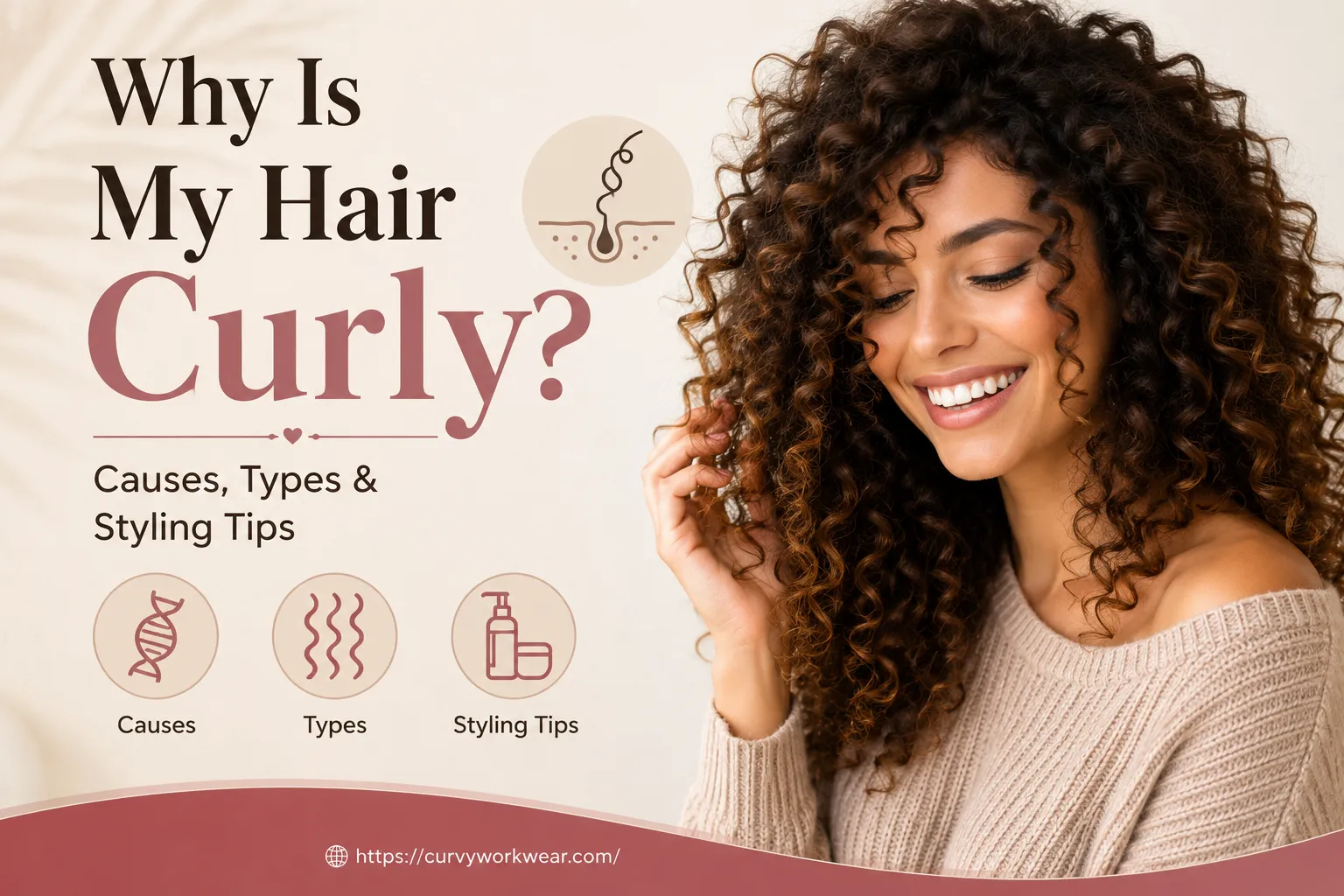
Grab a strand of your hair and look at it closely. Does it bend, twist, or spiral no matter what you do? There’s a reason for that, and it has nothing to do with luck.
Hair is curly because of how it grows beneath your skin, long before it ever reaches a comb or a mirror. The shape of the tiny pocket it grows from, combined with the way protein strands link together, decides whether you end up with straight locks, loose waves, or tight coils.
Below, we’ll walk through the biology behind curls, how to spot your specific curl type, and practical ways to style and care for your curls without damaging them. Think of this as the one guide you’ll need on the subject.
What Causes Curly Hair? The Science Made Simple
Three main factors decide your hair’s shape: the follicle it grows from, the protein structure inside each strand, and the genes you inherited.
Follicle Shape Sets the Foundation
Every strand of hair starts inside a follicle, a small opening in your scalp. A round follicle produces hair that grows out straight. A follicle that’s oval or slightly flattened pushes hair out at an angle, forcing it to bend.
Picture squeezing toothpaste out of a tube with a round nozzle versus a flat, wide nozzle. The round nozzle gives you a neat straight line. The flat one makes the toothpaste curl and twist as it comes out. Your hair follicles work in a surprisingly similar way.
Protein Bonds Decide the Curl
Hair is built mostly from keratin, a strong protein. Inside each strand, chains of keratin connect through bonds, and one type, called disulfide bonds, plays a big role in shaping hair.
In straight strands, these bonds sit evenly on both sides. In curly strands, they’re lopsided. One side of the hair grows a little faster or tighter than the other side, and that small imbalance forces the strand to curve as it lengthens.
Genetics Ties It All Together
Curl pattern runs in families. Scientists have linked certain genes, including one called trichohyalin, to how hair fibers form and behave.
Genetics can still surprise you, though. Two straight-haired parents can have a curly-haired child if they both carry a hidden gene for curls. This explains why siblings sometimes end up with completely different hair textures.
Why Is My Hair Naturally Curly?
If your curls go back to childhood, they’re almost certainly written into your DNA. Naturally curly hair tends to hold a steady pattern for most of your life, even though weather and hair products can change how it looks day to day.
This is different from hair that becomes curly later in life because of hormones, medication, or a health condition. Genetic curls usually match a family member’s, whether that’s a parent, aunt, or grandparent.
Quick Signs Your Curls Are Genetic
- Your hair curled before you could even hold a comb
- A close relative has a similar curl shape
- Your curl pattern barely shifts outside of humidity
- Your hair reacts to water in a predictable way
If straight hair suddenly turns curly in adulthood, hormonal changes are often the reason, especially during pregnancy or with thyroid issues. This shift isn’t usually a medical emergency, but it’s worth bringing up at your next checkup if it happens fast.
Why Is My Hair So Curly? What Controls Curl Tightness
No two curls are exactly alike. Some people have soft, loose waves. Others have curls so tight they coil into small rings. The main reason comes down to how flat or oval your follicle is.
A follicle with a mild oval shape creates a loose, relaxed wave. A follicle that’s almost flat produces a tight, springy coil. The flatter the shape, the more dramatic the curl.
Weather adds another layer to this. Curly strands have a rougher outer surface, called the cuticle, compared to straight hair. That rough texture absorbs moisture from the air more easily, which is why curls often tighten or frizz when it’s humid outside. Your curls aren’t acting out. They’re simply reacting to moisture in the air.
Breaking Down Curly Hair Types
Stylist Andre Walker introduced a hair typing chart back in the 1990s, and it’s still the go-to reference today. It runs from Type 1, straight hair, up to Type 4, tightly coiled hair.
Type 2: Wavy Hair
Type 2 hair sits between straight and curly, forming a loose S-shape.
- 2A: Subtle, barely visible waves
- 2B: Clearer waves with some volume
- 2C: Strong waves that almost turn into curls
Type 3: Curly Hair
Type 3 hair forms noticeable, springy loops.
- 3A: Wide, loose curls, similar to a coiled spring
- 3B: Bouncy curls, tighter than 3A
- 3C: Tight, corkscrew-shaped curls
Type 4: Coily Hair
Type 4 hair has the tightest curl pattern on the chart, often shaped like a small zigzag.
- 4A: Springy coils with a visible pattern
- 4B: Z-shaped coils, less defined
- 4C: Very tight coils with the least visible curl shape
Most people don’t have just one curl type across their whole head. It’s common to have looser curls near the nape of the neck and tighter curls at the crown. That mix is completely normal.
Practical Styling Tips for Curly Hair
Curly hair doesn’t behave like straight hair, so it needs a slightly different routine. Natural oils from your scalp take longer to travel down curly strands because of all the twists and turns, which means curls tend to dry out faster.
Daily Habits Worth Building
- Wash less often. Washing curly hair every single day can strip it of natural oils. Two to three washes a week usually works better.
- Pick a sulfate-free shampoo. Sulfates tend to be too harsh for curly hair and can leave it feeling dry and rough.
- Never skip conditioner. Curls generally need more moisture than straight hair, so apply conditioner generously from mid-length to ends.
- Detangle while your hair is wet. A wide-tooth comb works best, starting from the ends and slowly working upward.
Getting Better Curl Definition
- Apply styling products to soaking wet hair. Curl creams and gels grip better when hair is dripping wet, not just damp.
- Scrunch instead of rubbing. Rubbing curls with a regular towel causes frizz. A microfiber towel or soft t-shirt works better for scrunching out excess water.
- Let curls air dry when you can. Frequent heat styling can loosen your natural curl pattern over time. If you do use heat, a diffuser on a low setting is gentler.
- Refresh curls the next day. A light spray of water mixed with leave-in conditioner can bring curls back to life without a full wash.
For more detailed help, you may want to look into a guide on choosing curl creams for different hair textures, or an article breaking down how often curly hair actually needs washing.
Does Curl Pattern Change With Age?
Yes, and this catches a lot of people off guard. Hormonal shifts during puberty, pregnancy, or menopause can slightly reshape hair follicles over time, which changes how curly or straight hair appears.
Hair also tends to get finer as people age, and finer strands often hold less curl definition. In short, the curls you had at 20 might not look exactly the same at 50, and that’s a normal, expected change rather than a sign of damage.
FAQ: Common Questions About Curly Hair
Why is my hair curlier on some days than others?
Humidity, the products you use, and your drying method all affect how defined your curls look on a given day. Humid air usually makes curls tighten up, while dry air can loosen them.
Can curly hair be straightened for good?
Yes, chemical straightening treatments can permanently alter curl pattern by breaking down the same protein bonds responsible for the curl shape. These treatments can weaken hair strands, so getting professional advice first is a smart move.
Is curly hair weaker than straight hair?
In general, yes, curly hair is more prone to breakage. The bends along each strand create natural weak spots, so regular conditioning and gentle handling go a long way in keeping curls strong.
My hair turned curly out of nowhere as an adult. Why?
A sudden shift like this is often tied to hormonal changes, certain medications, or an underlying health condition. If it happens quickly and without a clear reason, it’s worth mentioning to a doctor.
Will cutting my curly hair make the curls tighter?
No, a haircut doesn’t change your curl pattern, since curls form at the follicle, not at the ends. That said, trimming away damaged or heavy ends often helps curls bounce back and look more defined.
Conclusion
Your hair is curly because of a mix of follicle shape, uneven protein bonding, and the genes passed down to you. None of it is random, even on days when your curls feel unpredictable.
Learning your curl type and adjusting your routine to match it makes a real difference. Instead of constantly fighting your natural texture, you can work with it and end up with healthier, more defined curls.
If you’re still finding your routine, start with the basics. Switch to a sulfate-free shampoo, apply products to soaking wet hair, and give your curls a few weeks to settle into a new rhythm. Chances are, your curls will respond better than you expect.