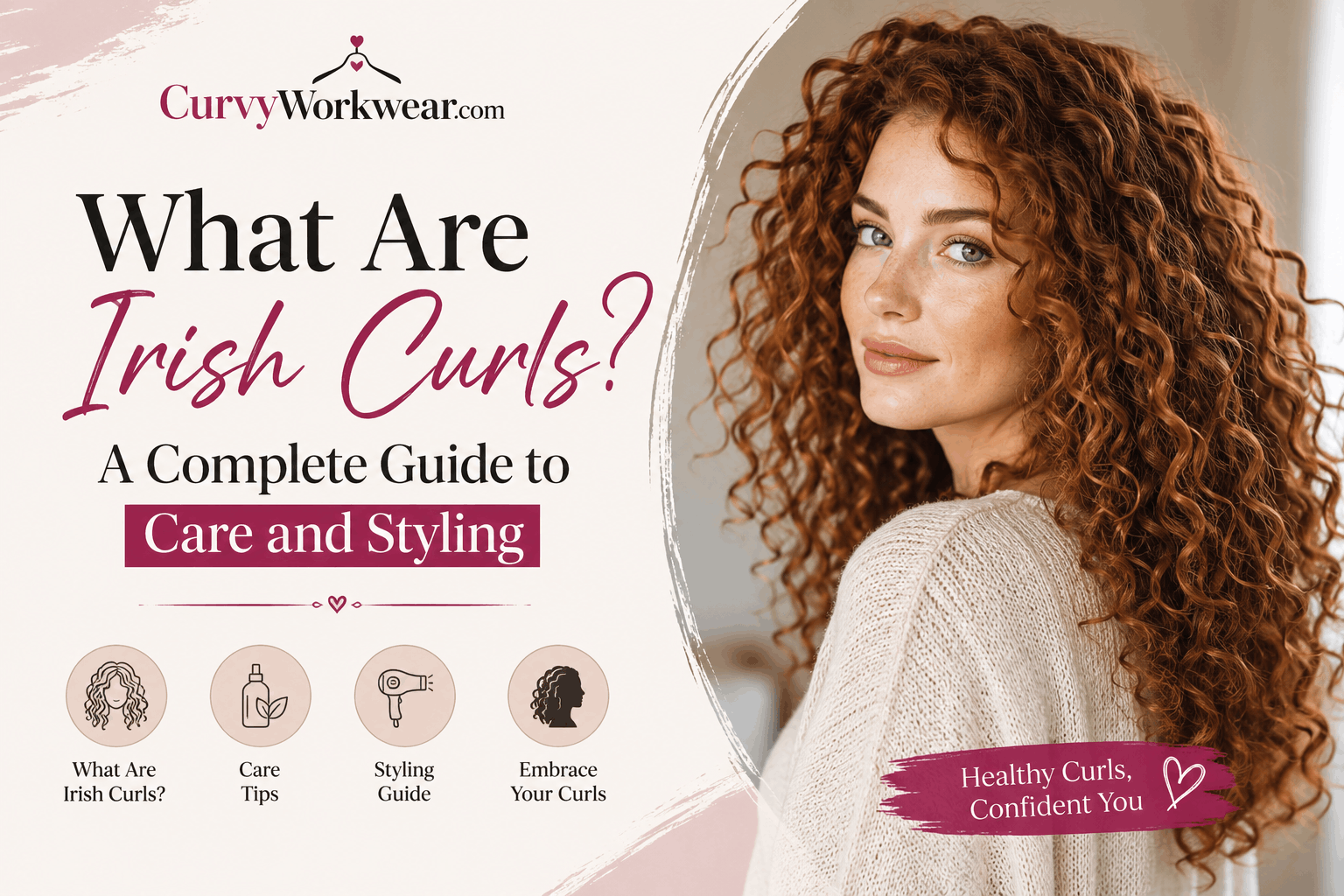
Ever noticed your hair looks straight on top but turns into loose curls or waves underneath? You’re not imagining things, and you’re not alone. This mixed texture has a name: Irish curls.
Thousands of people have discovered this term on social media over the past couple of years, finally putting a label on a hair pattern they’ve dealt with their whole lives. If you’ve ever felt confused about whether to flat iron your hair or let it curl, this guide is for you.
We’ll cover what Irish curls actually are, why they happen, and how to care for and style them so your whole head of hair looks like it belongs together.
What Are Irish Curls?
Irish curls describe a hair pattern where the top layer of hair is noticeably straighter than the layers underneath. The underlayers, especially from around the back of your head down, tend to be wavy or curly.
In simple terms, it’s like having two hair types on one head. The canopy (top layer) behaves one way, and the hidden layers underneath behave completely differently.
This isn’t a medical condition or anything unusual. It’s simply a natural variation in hair texture, and it’s actually quite common among people with wavy or curly hair in general.
Why Is It Called “Irish Curls”?
The name comes from social media, particularly TikTok, where the trend of labeling this texture “Irish hair” or “Irish curls” took off. Many people who posted about this pattern happened to have Irish or Celtic heritage, so the name stuck.
However, it’s worth being clear about something: there’s no scientific proof linking this hair pattern to Irish ancestry specifically. People from all kinds of backgrounds, with zero Irish heritage, have this same mixed texture. The name is more of a cultural nickname than a scientific classification.
Irish Curls vs. the Standard Curl Chart
Most people know curl types through the 1 to 4 system (straight, wavy, curly, coily). Irish curls don’t fit neatly into just one number on that chart.
That’s because a single head of Irish curls might have straighter, almost type 1 or 2 hair on top, and looser type 2B or 3A curls underneath. So instead of one curl type, you’re really working with two or more.
What Causes Irish Curly Hair?
Genetics play the biggest role here. Hair follicles are shaped differently across your scalp, and follicle shape determines whether a strand grows straight, wavy, or curly.
If the follicles on top of your head are rounder or straighter, that hair grows smoother. If the follicles underneath are more oval or asymmetrical, that hair coils or waves as it grows out. This is the same basic science that explains all curl types, not just Irish curls; dermatology researchers have confirmed that follicle shape is a key driver of hair texture.
Other Factors That Can Affect the Pattern
Genetics isn’t the only piece of the puzzle. A few other things can make the difference between your top and bottom layers more or less noticeable:
- Heat and sun damage: The top layer gets the most sun exposure, heat styling, and friction from brushing, which can weaken curls over time and make them look straighter.
- Haircut and layers: Blunt cuts with minimal layers tend to weigh the top hair down, making the contrast between layers more obvious. Layered cuts often let curls show through more evenly.
- Drying time: Underlayers hold onto moisture longer when hair air-dries, which helps them curl more. The top layer dries faster and often ends up straighter and a little frizzier.
Advantages and Disadvantages of Irish Curls
Like any hair texture, Irish curls come with some perks and some challenges. Knowing both sides helps you set realistic expectations for your routine.
Advantages
- Natural volume: The straighter top layer keeps hair from looking flat, while the curl underneath adds body and movement.
- Styling flexibility: You can wear it curly, straight, or somewhere in between, depending on the day.
- Bangs and face-framing pieces work well: Because the canopy is straighter, bangs are usually easier to manage than they are on fully curly hair.
Disadvantages
- Uneven texture can look unintentional: Without the right routine, the mismatch between layers can look messy rather than styled.
- Two-texture care takes more time: You’re essentially caring for two hair types at once, which means more product knowledge and a bit more effort.
- Frizz on top: The straighter canopy is more exposed to sun, heat, and friction, so it tends to frizz faster than the curlier layers underneath.
How to Care for Irish Curls
Caring for this hair type means balancing two different textures at once. What works for your curly underlayer might not be enough for your straighter top layer, and vice versa.
Choose the Right Shampoo and Conditioner
Look for a sulfate-free, moisture-focused shampoo. Sulfates can strip natural oils, which affects curl definition more than straight hair.
Apply conditioner mainly from mid-shaft to the ends. Piling conditioner near your roots can weigh down the straighter top layer and make your whole head look flat. If you color-treat your hair, a routine built around keratin-based hair care can also help both layers stay smoother and less prone to breakage.
Don’t Skip Leave-In Products
A lightweight leave-in conditioner or curl cream helps define the curly underlayer without making the top layer greasy or heavy. Focus product on the sections that actually curl, and use a lighter hand on top.
Detangle Gently
Use a wide-tooth comb or your fingers on wet, conditioned hair. Curly underlayers tangle more easily than straight sections, so take your time and start from the ends, working up.
Protect Hair From Heat and Sun
Since the top layer takes the most damage from sun and styling tools, a heat protectant spray and a hat on sunny days can go a long way. Reducing damage helps prevent the top layer from looking permanently straighter than the rest.
If you also color your hair, keep in mind that color-treated strands need extra care to stay healthy. For example, if you have highlights or ombre color, the lightened sections can dry out faster and change how your curl pattern behaves.
How to Style Irish Curls
Styling Irish curls is really about creating consistency between two different textures, so your hair reads as one cohesive look instead of two separate ones.
Air-Drying Techniques
Air-drying is one of the easiest ways to let your natural curl pattern show. Try scrunching a curl cream or mousse into damp hair, focusing on the underlayers, then let it dry without touching it too much.
For the straighter top section, you can scrunch in a texturizing spray to help it blend in with the curlier hair underneath.
Diffusing for More Definition
If air-drying doesn’t give you enough curl definition, a diffuser attachment on your blow dryer can help. Use a low heat and low speed setting, and cup sections of hair in the diffuser bowl rather than aiming the airflow directly at your scalp.
Styling Tools That Can Help
A few tools tend to work especially well for Irish curls:
- Curling wand or iron: Great for adding curl to the straighter top layer so it matches the natural curl underneath.
- Flat iron: Some people prefer to smooth the whole head into one consistent straight style instead.
- Diffuser: Helps enhance natural curl without adding heat damage from direct blow-drying.
Haircuts That Work Well
Layered cuts and shags often help Irish curls look more uniform because they let the curlier underlayers peek through the straighter top sections. Bangs can also work nicely, since the shorter length near the face tends to show more texture than longer, heavier pieces.
Talk to your stylist about where your curl pattern starts on your head. A cut that respects that transition point usually looks more natural than a generic cut.
If you’ve colored your hair blonde or have highlights, brassiness can also throw off how uniform your texture looks. In that case, purple shampoo can help keep tones balanced across both the straight and curly sections.
Common Mistakes to Avoid
- Using the same product on your whole head. Your straight and curly sections have different needs, so a one-size-fits-all approach often leaves one layer looking off.
- Over-brushing curly sections. Brushing dry curls breaks up the curl pattern and creates frizz. Stick to detangling wet hair with a wide-tooth comb.
- Skipping heat protection. The top layer already takes the most damage from sun and daily styling, so protecting it matters more than you might think.
- Ignoring your haircut. The wrong cut can make the contrast between your two textures more obvious than it needs to be.
FAQ: Irish Curls
What are Irish curls exactly?
Irish curls are a hair pattern where the top layer of hair is straighter and the underlayers are wavier or curlier. The name comes from social media trends rather than an official hair-type classification.
Do you have to be Irish to have Irish curly hair?
No. This texture shows up in people from many different ethnic backgrounds. The name is a nickname that became popular online, not a genetic requirement.
Is Irish curly hair a specific curl type on the curl chart?
Not exactly. It’s more like having two curl types on one head, often a straighter type 1 or 2 texture on top and a looser type 2 or 3 texture underneath.
Can Irish curls change over time?
Yes, to some extent. Heat styling, sun exposure, hormonal changes, and even how you cut your hair can all affect how noticeable the difference between your layers is.
What’s the best way to style Irish curls for an even look?
Many people get the best results from layered haircuts, lightweight curl-defining products on the underlayers, and either a diffuser or curling wand to help the top layer blend in with the curl underneath.
Conclusion
Irish curls aren’t a mystery or a hair “problem” to fix. They’re simply a natural mix of textures, straight on top and curly or wavy underneath, that a lot of people share regardless of their actual heritage.
Once you understand why your hair behaves this way, caring for it gets a lot easier. Use lighter products up top, richer moisture underneath, protect your hair from heat and sun, and consider a haircut that works with your pattern instead of against it.
If you’re still figuring out your exact texture, pay attention to how each layer of your hair dries and reacts to different products. Your Irish curls are unique to you, and with the right routine, they can look effortlessly put-together every day.
Disclaimer:Irish curls is a hair-texture term that became popular on social media rather than an official term used in dermatology or trichology. The care tips in this guide are general hair-styling advice. If you have ongoing scalp or hair health concerns, it’s best to check with a dermatologist or licensed trichologist.