Introduction
Shopping for a diamond can feel like learning a new language. One term you’ll run into again and again is “VVS diamonds.” But what does it actually mean, and does it matter for your ring?
In short, VVS stands for a diamond clarity grade that sits near the top of the scale. It means the diamond has almost no visible flaws, even under magnification. This guide breaks down everything you need to know about VVS diamonds, from what the letters mean to whether they’re worth the extra cost.
By the end, you’ll know exactly how to shop smarter and avoid overpaying for clarity you can’t even see.
What Are VVS Diamonds? The Basics Explained
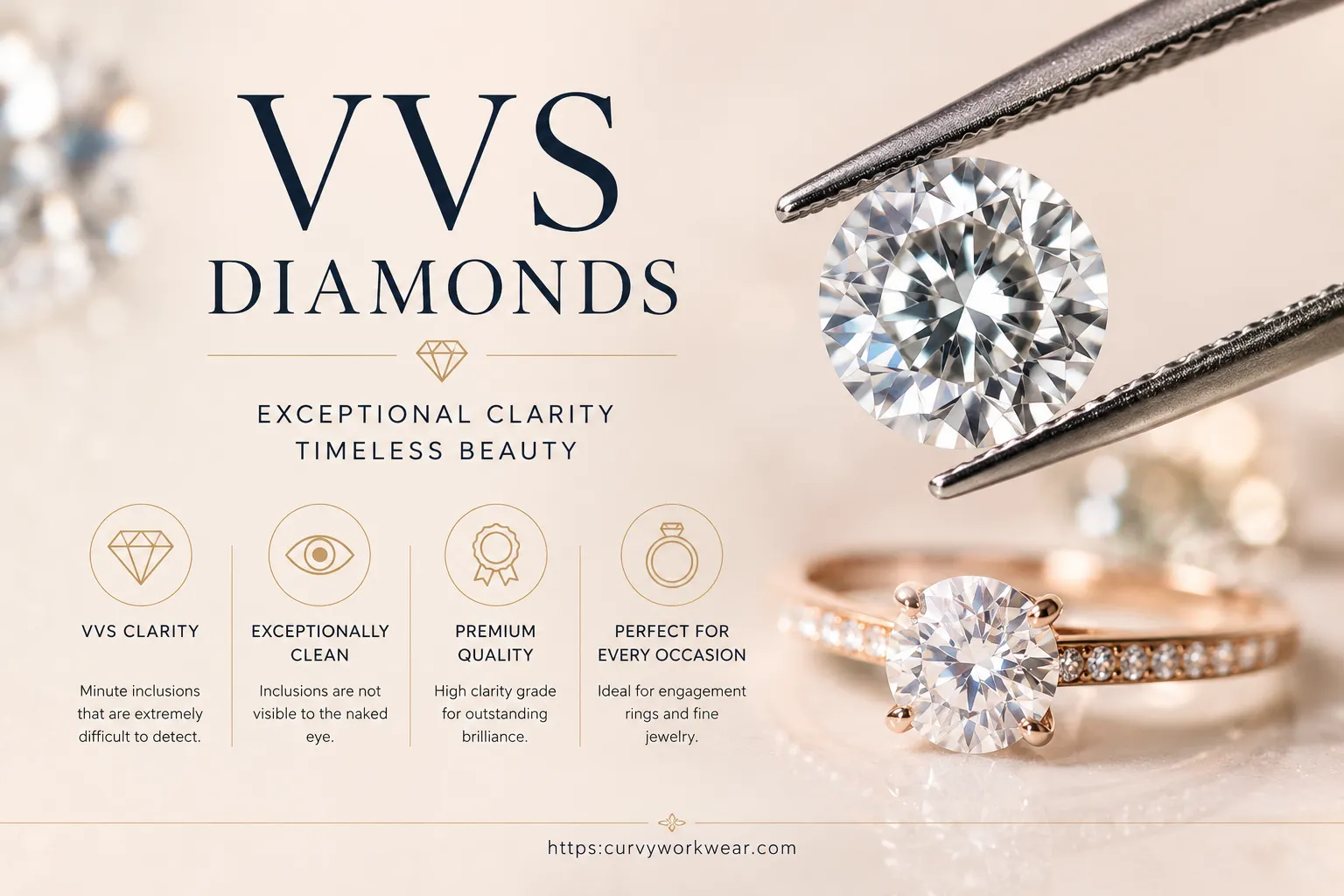
VVS diamonds are diamonds with a clarity grade of “Very, Very Slightly Included.” This grade comes from the GIA (Gemological Institute of America), the lab that created the modern diamond grading system and is widely seen as the industry standard.
Every diamond forms deep underground under intense heat and pressure. During that process, tiny marks can form inside or on the surface of the stone. These marks are called inclusions (inside) or blemishes (outside).
The fewer and smaller these marks are, the higher the clarity grade. VVS diamonds have inclusions so small that even a trained jeweler needs 10x magnification to spot them. A VVS diamond appears completely clear and flawless to the naked eye.
Where VVS Sits on the Clarity Scale
The GIA clarity scale runs from Flawless (no marks at all) down to Included (marks visible without magnification). Here’s the order, from best to lowest:
- FL (Flawless)
- IF (Internally Flawless)
- VVS1 and VVS2 (Very, Very Slightly Included)
- VS1 and VS2 (Very Slightly Included)
- SI1 and SI2 (Slightly Included)
- I1, I2, I3 (Included)
VVS sits just two steps below Flawless. According to the American Gem Society’s clarity scale guide, VVS1 and VVS2 diamonds have inclusions that are difficult for even a skilled grader to see under 10x magnification. This puts VVS in the top tier of clarity, but at a lower price than an FL or IF diamond.
VVS Diamonds Meaning: VVS1 vs VVS2
The VVS diamonds meaning actually splits into two grades: VVS1 and VVS2. Both are excellent, but there’s a small difference between them.
VVS1
VVS1 diamonds have inclusions that are extremely hard to find, even for a trained gemologist using a jeweler’s loupe. These marks are usually located near the edge (girdle) of the diamond, making them even harder to spot.
VVS2
VVS2 diamonds have inclusions that are still tiny, but slightly easier to locate under magnification than VVS1. The difference between VVS1 and VVS2 is nearly impossible to see without proper training and tools.
For most buyers, the visual difference between VVS1 and VVS2 doesn’t matter. Both look flawless to the eye. However, VVS1 usually costs a bit more because of its higher rarity.
VVS Diamond Clarity: What You Can (and Can’t) See
Here’s the part that surprises a lot of buyers. VVS diamond clarity is graded using 10x magnification, not the naked eye.
This means the inclusions in a VVS diamond are invisible in everyday viewing, whether you’re looking at the ring on your hand or across a dinner table. Nobody, including you, will ever see these flaws without a special tool.
Why This Matters for Your Wallet
Since VVS clarity is invisible to the naked eye, you’re paying mostly for peace of mind and a higher grade certificate. For example, a VS1 or VS2 diamond often looks just as clean to a normal viewer, but costs noticeably less.
Think of it like buying a car with a slightly higher horsepower engine than you’ll ever actually use on regular roads. You get the specification, but you may not experience much real-world difference.
That said, some buyers care about having the best of the best on paper. That’s a personal choice, not a mistake.
VVS Diamonds: Advantages and Disadvantages
Before you decide, it helps to weigh what VVS clarity actually gives you against what it costs.
Advantages of VVS Diamonds
- Near-invisible inclusions. VVS diamonds look completely clean to the naked eye, in any lighting.
- Strong resale and appraisal value. Higher clarity grades tend to hold value better over time.
- Peace of mind. You know your stone sits close to the top of the official clarity scale, which can matter for insurance or future appraisal.
- Good for larger stones. Inclusions can be easier to spot in bigger diamonds, so higher clarity offers more of a safety margin as carat size goes up.
Disadvantages of VVS Diamonds
- Higher price for invisible detail. You’re often paying extra for something no one, including you, will ever see without a loupe.
- Diminishing returns. Moving from VS1 to VVS2 rarely changes how the diamond looks, but it does raise the price.
- Budget trade-off. Money spent on clarity is money not spent on cut quality or carat size, both of which affect appearance more.
- Limited availability in some shapes and sizes. VVS stones can be harder to find in certain cuts, which may narrow your options.
VVS Diamonds vs Other Clarity Grades
It helps to compare VVS diamonds side by side with nearby grades so you can see where your money actually goes.
VVS vs VS (Very Slightly Included)
VS1 and VS2 diamonds still look eye-clean in almost all cases. The inclusions are a little more visible under magnification than VVS diamonds, but rarely visible without it. Many jewelers consider VS1 the sweet spot between quality and price.
VVS vs SI (Slightly Included)
SI1 diamonds can still look clean to the eye, especially in smaller carat sizes. SI2 diamonds sometimes show a small mark visible without magnification, depending on the stone. This is where you start to see real trade-offs in appearance.
VVS vs FL/IF (Flawless)
Flawless and Internally Flawless diamonds have no visible inclusions even under magnification, or none inside the stone at all. These are extremely rare and priced much higher than VVS, often for a difference nobody but a lab can detect.
Do VVS Diamonds Cost More? Understanding the Price Factor
Yes, VVS diamonds generally cost more than lower clarity grades. However, clarity is only one part of the pricing picture.
Diamond price depends on the “4Cs”: Carat, Cut, Color, and Clarity. A VVS diamond with a poor cut can actually look less sparkly than a VS diamond with an excellent cut. In short, clarity alone doesn’t decide beauty.
What Actually Affects a Diamond’s Sparkle
- Cut quality has the biggest impact on how much a diamond shines
- Color grade affects whether the stone looks white or slightly yellow
- Carat size affects how big the diamond looks, not how clean it is
So before choosing VVS clarity, it’s worth asking whether that budget is better spent on a better cut grade instead. Many jewelers and appraisers recommend prioritizing cut first, especially for round diamonds.
Are VVS Diamonds Worth It? How to Decide
This depends on your budget, priorities, and what matters most to you.
Choose VVS diamonds if you want the highest clarity grade that’s still reasonably priced, you plan to have the diamond appraised or want top-tier documentation, or budget isn’t a major limiting factor.
Consider VS or SI grades if you want an eye-clean diamond without paying for invisible detail, you’d rather put more budget toward carat size or cut quality, or you’re buying on a moderate budget and want the best overall value.
There’s no wrong answer here. A well-cut VS1 diamond can look just as stunning as a VVS diamond to everyone who sees it, including you. If you’re shopping for a complete look rather than just the stone, browsing jewelry and accessory pairings can help you picture how the ring fits your overall style.
How to Buy a VVS Diamond the Smart Way
If you decide VVS clarity is right for you, keep these tips in mind.
Always Ask for a Certificate
Buy only from a diamond that comes with a certificate from a trusted lab like GIA or AGS. This confirms the clarity grade is accurate and not just a seller’s claim.
Compare the Grading Report to the Stone
Ask to see the plotting diagram on the certificate. It shows exactly where each inclusion sits inside the diamond, so you know the grade matches the actual stone.
Don’t Skip the Cut Grade
Even a VVS diamond can look dull with a poor cut. Always check for an “Excellent” or “Very Good” cut grade alongside the clarity grade.
Shop From a Reputable Seller
Whether buying online or in-store, choose sellers with clear return policies and independent lab certification. This protects you if the diamond doesn’t match its listed grade. If you’re building a full gift set around the ring, our gift guide collection has ideas for pairing pieces thoughtfully, and a well-chosen watch can round out the presentation.
FAQ: Common Questions About VVS Diamonds
What does VVS mean in diamonds?
VVS stands for “Very, Very Slightly Included.” It’s a clarity grade showing the diamond has extremely tiny inclusions that are hard to see even under 10x magnification.
Is VVS1 or VVS2 better?
VVS1 is slightly higher than VVS2 on the clarity scale, meaning its inclusions are even harder to detect. In everyday wear, the difference is not visible to the naked eye.
Can you see inclusions in a VVS diamond without a microscope?
No. VVS diamond inclusions are only visible under professional magnification, typically 10x. To the naked eye, VVS diamonds appear completely clean.
Are VVS diamonds more expensive than VS diamonds?
Yes, VVS diamonds usually cost more than VS diamonds because of their higher clarity grade. However, the visual difference between the two is often too small to notice without magnification.
Is VVS clarity necessary for an engagement ring?
Not necessarily. Many jewelers suggest VS1 or VS2 clarity for engagement rings since they look eye-clean at a lower price. VVS is a good choice if you want top-tier clarity and have the budget for it.
Conclusion
VVS diamonds sit near the very top of the clarity scale, just below Flawless. They offer stunning, eye-clean beauty backed by an impressive grading report. However, since VVS diamond clarity is invisible to the naked eye, the extra cost mainly buys peace of mind rather than visible sparkle.
Before you buy, weigh your priorities. If a top clarity grade matters to you, VVS diamonds are a solid choice. If you’d rather stretch your budget toward a bigger carat size or a better cut, a VS grade diamond might serve you just as well.
Whichever you choose, always ask for a certified grading report so you know exactly what you’re paying for.are a solid choice. If you’d rather stretch your budget toward a bigger carat size or a better cut, a VS grade diamond might serve you just as well.
Whichever you choose, always ask for a certified grading report so you know exactly what you’re paying for.
Disclaimer: This article is for general informational purposes only and does not constitute professional gemological, financial, or legal advice. Diamond grades and prices may vary, so always verify certification with a reputable gemologist or jeweler.